Financial Guides ·

Learn before you borrow.

Six straight-talking guides from the Cash Central team — what these loans actually cost, when they make sense, how to compare them honestly, and how to use them without making a bad situation worse.

What Is a Payday Loan? A 2026 Beginner's Guide
01 Payday Loans 6 min read

What Is a Payday Loan? A 2026 Beginner's Guide

A payday loan is a short-term, small-dollar cash advance designed to bridge a single expense between paychecks. Understanding how the product actually works — and how its cost is structured — helps you decide whether it's the right tool for the bill you're facing.

How a payday loan actually works

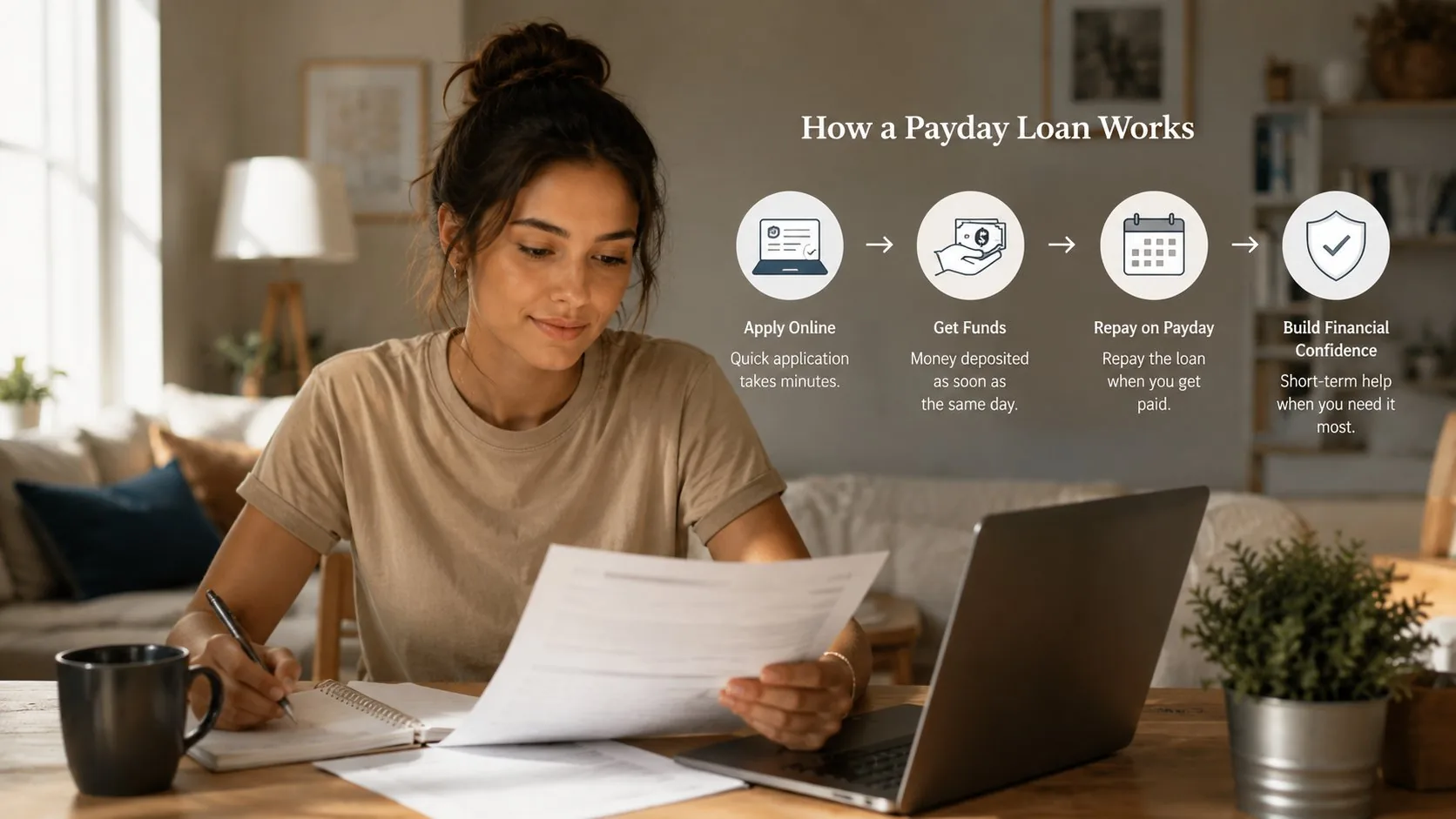
You borrow a small amount, usually $200 to $1,000, and agree to repay it in full on your next payday — typically 14 to 30 days later. Funds are deposited directly into your checking account, and on the due date the lender debits the same account for the loan plus its fee.

There is no collateral and no multi-month installment schedule. It is one loan, one payment, one short window — built to solve a single, time-sensitive problem.

What you typically need to qualify

Most direct lenders ask for four things:

A traditional FICO score is generally not the gating factor. Cash Central, for example, evaluates income consistency and bank-history signals rather than relying on a minimum credit score.

How costs are quoted (and where APR comes in)

Most lenders quote payday-loan costs as a flat fee per $100 borrowed (often $15–$30 per $100, depending on state law). On a 14-day loan that fee structure produces a high annualized percentage rate — sometimes 300%+ — because APR projects what you'd pay if you held the loan for a full year.

For a two-week loan, the more useful number is the total dollar cost: how much will you actually hand back? See our APR explainer for the full math.

When a payday loan makes sense

The honest answer: when the cost of the loan is less than the cost of the alternative. If a single overdraft fee, a missed-shift docked paycheck, or a $45 late penalty would cost more than the loan fee, the loan is the cheaper option.

Classic legitimate uses include medical co-pays, an urgent car repair that lets you keep working, an overdue utility bill where reconnection adds fees, or a one-time gap before a near-certain paycheck.

When it doesn't

Recurring monthly shortfalls. Discretionary purchases. Paying off other debt. These situations don't get solved by short-term credit — they get more expensive. If you're using payday loans repeatedly, that's a signal to talk to a non-profit credit counselor about cash-flow planning.

What's specific to Cash Central

Cash Central is a direct lender, not a broker. Every application, decision, deposit, and payment is handled in-house — no lead-sellers, no third-party processors, no surprise hand-offs. All fees, the total amount due, and the payment date are disclosed before you electronically sign anything.
Payday Loan vs. Installment Loan: Which One Should You Pick?
02 Compare 5 min read

Payday Loan vs. Installment Loan: Which One Should You Pick?

Payday loans and installment loans are both short-term consumer products, but they solve different problems. Picking the wrong one usually means paying more interest than you needed to — or stretching a small expense into a long obligation.

The payday loan: one payment, short window

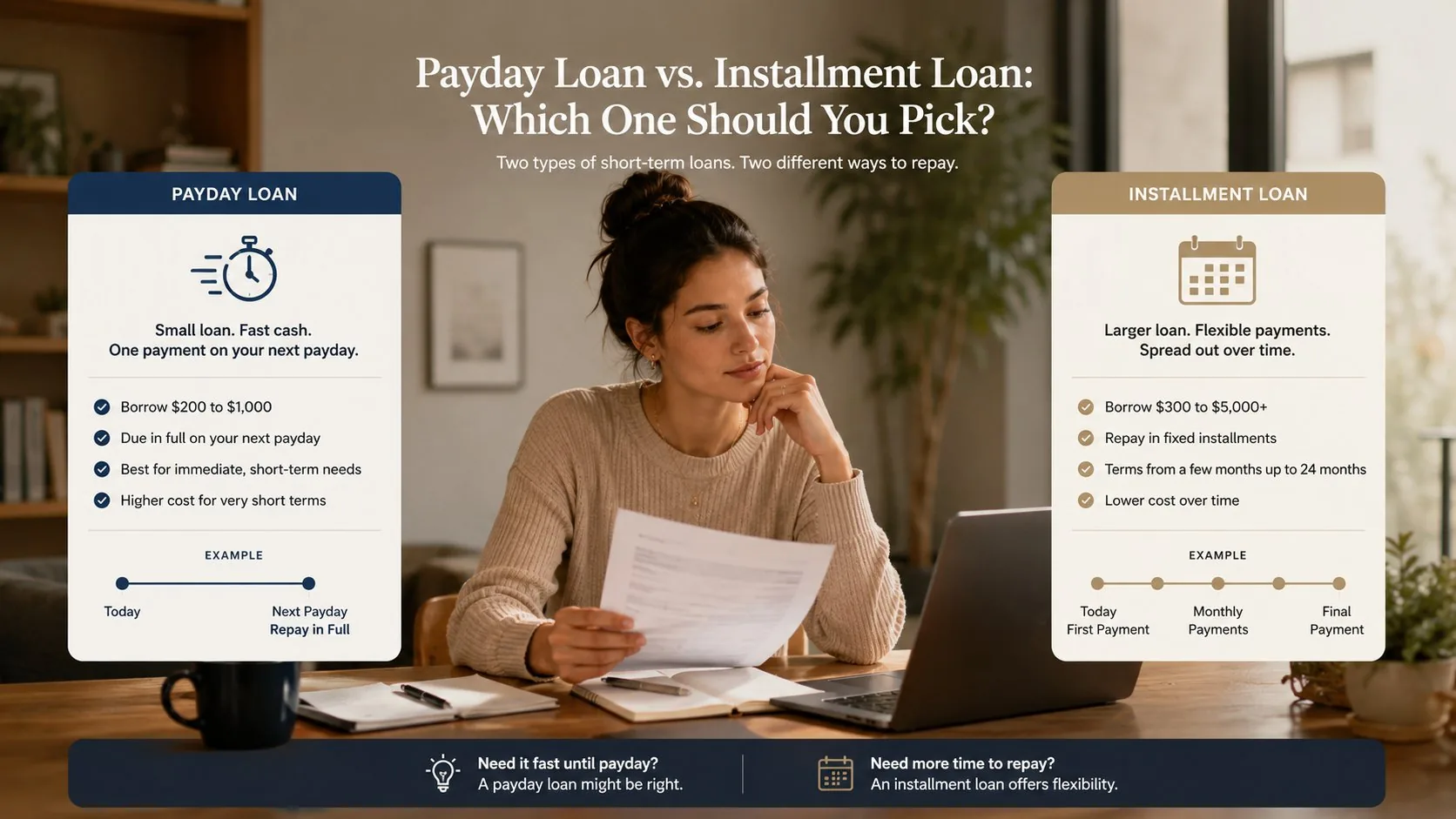
A payday loan is a single-payment product. Borrow $200–$1,000, repay in full on your next payday (typically two to four weeks later). The cost is a flat fee that doesn't compound — there's only one payment, one date, one balance.

Best for: a one-time, urgent expense you can cover from your next paycheck.

The installment loan: many payments, longer horizon

An installment loan is repaid over 6 to 24 months in fixed monthly chunks. Borrow $300–$5,000, then make predictable payments that include principal and interest until the loan is closed.

Best for: a larger expense you can absorb in monthly pieces, or a situation where one paycheck simply can't cover the balance.

Cost over time

The two products have different cost shapes:

Pick the loan whose timeline matches your cash flow. Don't take an installment loan for a two-week problem, and don't try to wedge a $3,000 medical bill into a single payday repayment.

The "right tool" decision

Ask one question: "Can I comfortably repay this in one shot on my next payday?"

If you're unsure, choose installment. A small loan paid early on an installment plan is almost always cheaper than rolling over a payday loan that you couldn't cover on time.

What you can prepay

Cash Central installment loans carry no prepayment penalty. If your situation improves — a tax refund, a bonus, a side-job payment — you can close the loan early and stop accruing interest. That option matters more than most borrowers realize.

Online Loans with Bad Credit (FICO under 600): What's Possible in 2026
03 Bad Credit 8 min read

Online Loans with Bad Credit (FICO under 600): What's Possible in 2026

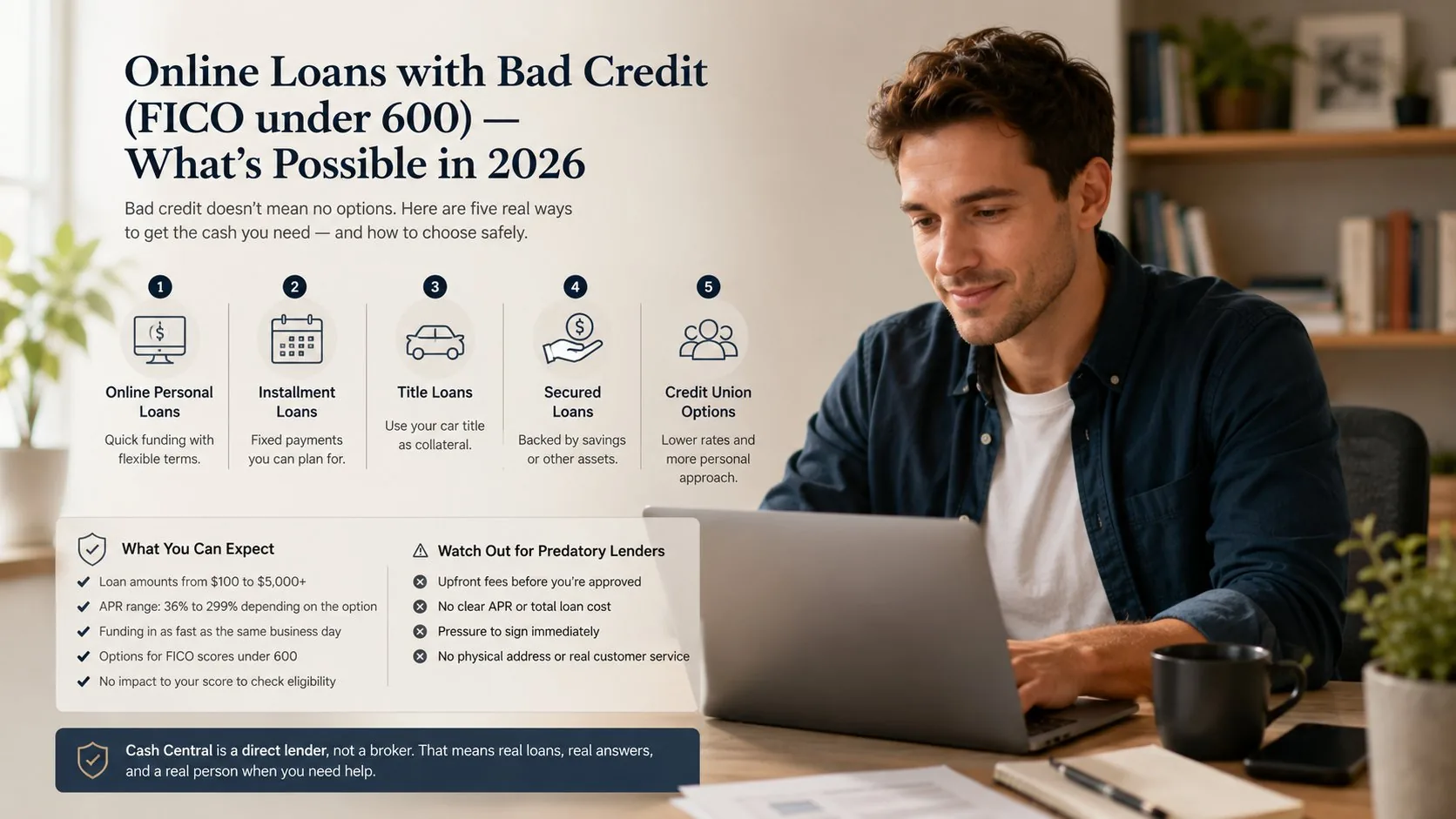
A FICO score below 600 narrows your options but doesn't close them. The trick is knowing which products are legitimate, what to expect on cost, and how to spot the genuine traps that target borrowers with damaged credit.

Online personal loans from alternative lenders

A growing number of online lenders score applicants on income consistency and bank-history signals, not just FICO. APRs in this segment generally fall between roughly 36% and 99% for installment products, and funding can be as fast as the same business day.

This is the most flexible option for borrowers whose credit history doesn't reflect their current ability to repay.

Installment loans

Spread a larger amount across 6–24 monthly payments. Predictable installments help with budgeting and let you avoid the rollover risk associated with single-payment products. Bad-credit installment loans typically range from $300 to $5,000 with capped state-specific APRs.

Title loans (proceed with extreme caution)

You borrow against your car's title and the lender holds it as collateral. APRs are typically very high and missed payments can trigger repossession of your vehicle. Only consider this product if you fully understand the repossession terms and have a clear payoff plan — losing transportation almost always costs more than the loan it secured.

Secured personal loans

A savings account, CD, or other deposit backs the loan. The lender holds your collateral until you repay — but the secured structure usually means a meaningfully lower APR than an unsecured bad-credit product. Many credit unions and community banks offer these.

Credit union options worth checking

Federally insured credit unions offer Payday Alternative Loans (PALs) with APR capped at 28%. Loan amounts are smaller (up to $2,000) and you may need to be a member for 30 days before qualifying — but for borrowers who can wait, the rate difference is significant.

Warning signs of a predatory operation

The following are not legitimate lending practices. If you see any of them, stop and look elsewhere:

What Cash Central does in this space

Cash Central is a state-licensed direct lender that considers applicants with all credit backgrounds — no minimum FICO. Eligibility checks don't impact your credit score, and every loan disclosure (APR, total fees, payment schedule) appears before you sign. Bad credit is not a barrier; income consistency and an active checking account are what matter most.

5 Smart Reasons to Use a Cash Central Loan (and 3 Bad Ones)
04 Smart Use 7 min read

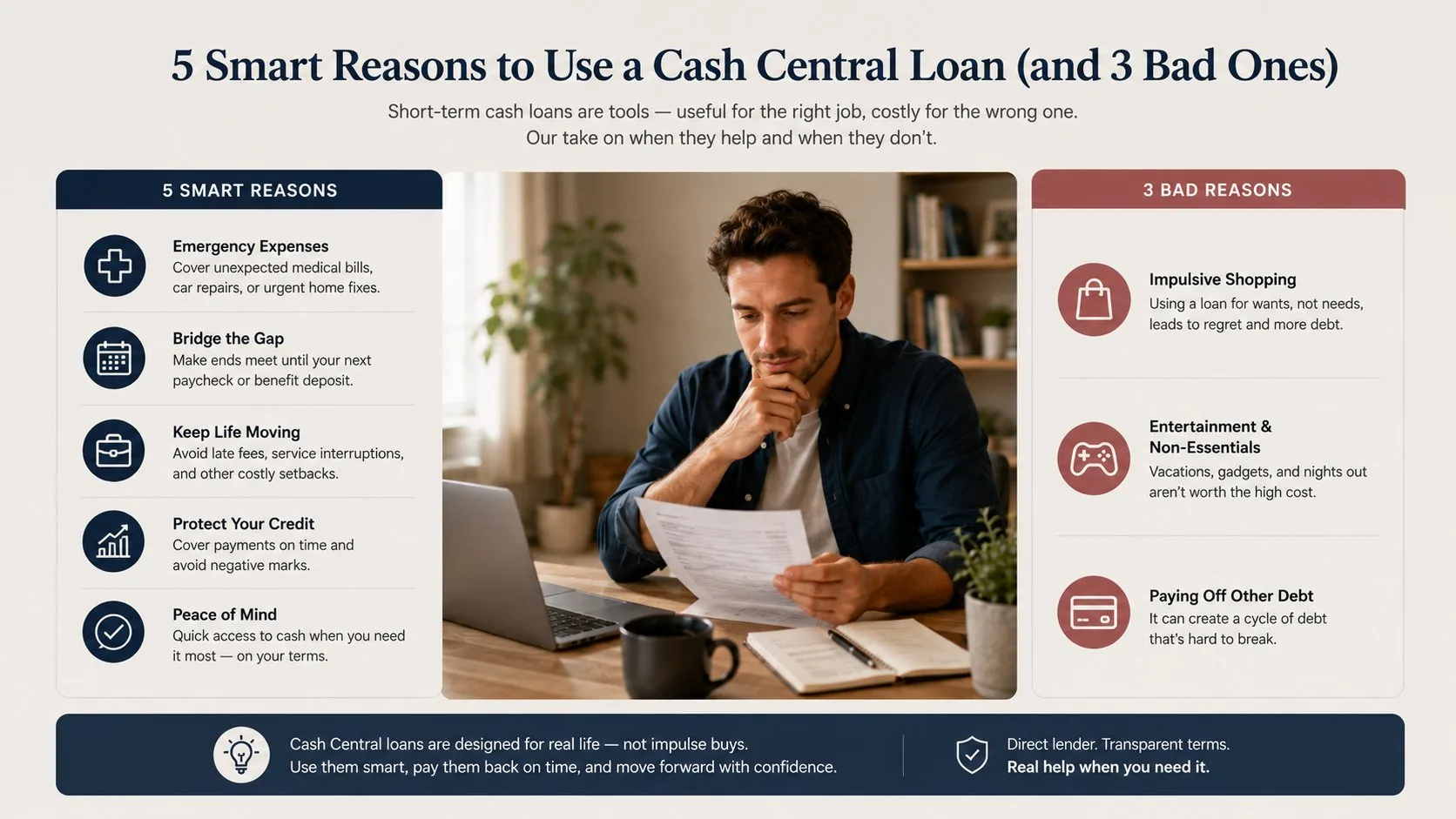
5 Smart Reasons to Use a Cash Central Loan (and 3 Bad Ones)

Short-term cash loans are tools — useful for the right job, costly for the wrong one. Here's our honest breakdown of when reaching for one makes sense, and when you're better off looking elsewhere.

Smart reason 1 — Emergency expenses

Unexpected medical bills, an urgent car repair, a critical home fix (busted pipe, broken AC in summer). These are situations where delay creates a bigger cost than the loan itself: a missed work shift, a worsening leak, a vet bill that doubles by tomorrow.

Smart reason 2 — Bridging the gap

A few days between a bill's due date and your next paycheck. The loan covers the gap so you don't trigger overdraft, late, or reconnection fees that would each independently cost more than the loan's own fee.

Smart reason 3 — Keeping life moving

Avoiding service interruptions (utilities, internet) or income-affecting setbacks (a commuter car that won't start). When your ability to earn depends on something working, fixing it quickly is rarely a luxury.

Smart reason 4 — Protecting your credit

Covering a payment on time keeps a negative mark off your credit history. A 30-day delinquency can drop a score by 60–100 points and take a year or more to recover from. Short-term credit, used once to avoid that, is often the cheaper long-run choice.

Smart reason 5 — Peace of mind

Knowing that a same-day funding option exists for genuine emergencies, even before you need it. Most borrowers report less day-to-day stress simply from having the option mapped out in advance.

Bad reason 1 — Impulsive shopping

Using a loan for wants rather than needs. The cost of credit makes the purchase more expensive, and the regret-to-utility ratio is usually grim. If you wouldn't pay cash for it today, borrowing doesn't change that calculation — it just delays the bill.

Bad reason 2 — Entertainment and non-essentials

Vacations, gadgets, nights out. None of these earn back their cost. None of them are emergencies. Save for them or skip them; don't finance them with short-term credit.

Bad reason 3 — Paying off other debt

Using a higher-cost loan to pay down a lower-cost one creates a cycle that's hard to escape. If you're juggling multiple debts, the right call is usually a free conversation with a non-profit credit counselor — not another loan.

Emergency Loans: A 6-Step Playbook for Fast Cash Without Wrecking Your Finances
05 Emergency 9 min read

Emergency Loans: A 6-Step Playbook for Fast Cash Without Wrecking Your Finances

When the bill is due today, the order of operations matters. Skip a step and you'll usually pay more than you needed to. Here's the sequence that protects both your wallet and your sanity.

Step 1 — Pause for one minute

Before doing anything else, ask: "Is this bill due today, or is it just stressful?" Today versus this week is a meaningful difference. A two-day window often lets you exhaust no-cost options before borrowing anything.

Step 2 — Exhaust the no-cost options first

In order, try:

These options cost zero. Use them first.

Step 3 — Compare the cost of the alternatives

If no-cost paths fail, run the math on the cost of not taking the loan: the overdraft fee, the late penalty, the reconnection charge, the missed-shift docked pay. Often the loan fee is cheaper than the consequence of doing nothing. Sometimes it isn't. Knowing which is which takes 90 seconds with a calculator and prevents most of the regret in this category.

Step 4 — Borrow only the minimum you need

Don't round up. Every dollar borrowed accrues cost. If you need $267 to cover a bill, borrow $267 — not the $500 the application offers you because it's convenient. The discipline here is the difference between solving the emergency and creating a new one.

Step 5 — Read the agreement before signing

Before you click "I agree," know four numbers:

If any of these are buried, unclear, or missing, the loan is not legitimate. Walk away.

Step 6 — Plan the payoff before the funds land

Name the source. Which paycheck, which refund, which deposit is covering this repayment? If you can't answer that question with one specific date and one specific source, the loan isn't a solution — it's a delayed problem.

Borrowers who set the payoff plan before the money lands repay on time about three times as often as those who don't. The plan is the whole game.

Understanding APR on Short-Term Loans: Why It Looks So High
06 Pricing 6 min read

Understanding APR on Short-Term Loans: Why It Looks So High

A $300 loan can carry a "300% APR" while costing only $45 in fees. That's not a contradiction — it's a math quirk that misleads more borrowers than it helps. Here's how to read APR honestly, and the better number to use instead.

What APR actually is

APR stands for Annual Percentage Rate. It's an annualized cost figure — a projection of what the loan would cost if you held it, at the same rate of fees, for one full year.

Notice the word projection. For a long-term loan (a car loan, a mortgage, a credit card) you actually do hold the balance for years, so APR is a fair comparison number. For a two-week loan, you don't.

Why short terms look extreme

Short-term loans are designed to be repaid in weeks, not years. Annualizing a two-week fee multiplies it by roughly 26. A $15 fee on $100, over 14 days, projects to about $390 over a year — even though you'll only ever pay the $15.

The APR isn't wrong, it's just measuring the wrong thing for this product. The disclosure is required by federal law (the Truth in Lending Act), but the number has to be interpreted, not taken at face value.

An example, side by side

Imagine you borrow $300 with a $45 fee for a 14-day term.

391% sounds alarming. $45 is what you actually pay. Both numbers are accurate; only one tells you how much money will leave your account.

The better number: total cost of credit

For short-term loans, ignore the APR percentage and look at the total amount you'll repay. Compare that to the cost of not borrowing (overdraft fee, late penalty, missed shift). That dollar-versus-dollar comparison tells you whether the loan makes financial sense for the specific situation.

When APR really matters

For products that you genuinely carry for months or years — installment loans, credit cards, personal loans — APR is exactly the right number to compare. The longer the loan, the more APR matters. The shorter the loan, the less it does.

Rule of thumb: if the term is under 60 days, lead with total dollar cost. If the term is over 60 days, lead with APR.

Cash Central's commitment

Every Cash Central loan agreement displays APR, total fees, total amount due, and the full payment schedule before you electronically sign. There are no buried numbers and no surprise costs. Whatever's on the agreement is what you pay — nothing more.

Ready when you are

Done reading? Start your application.

Apply in three minutes. Real-time decision. Funds in your checking account as soon as the same business day for approved requests.

Apply Now — Get Cash Today → Run the loan calculator first